Author: Aliquip laudantium
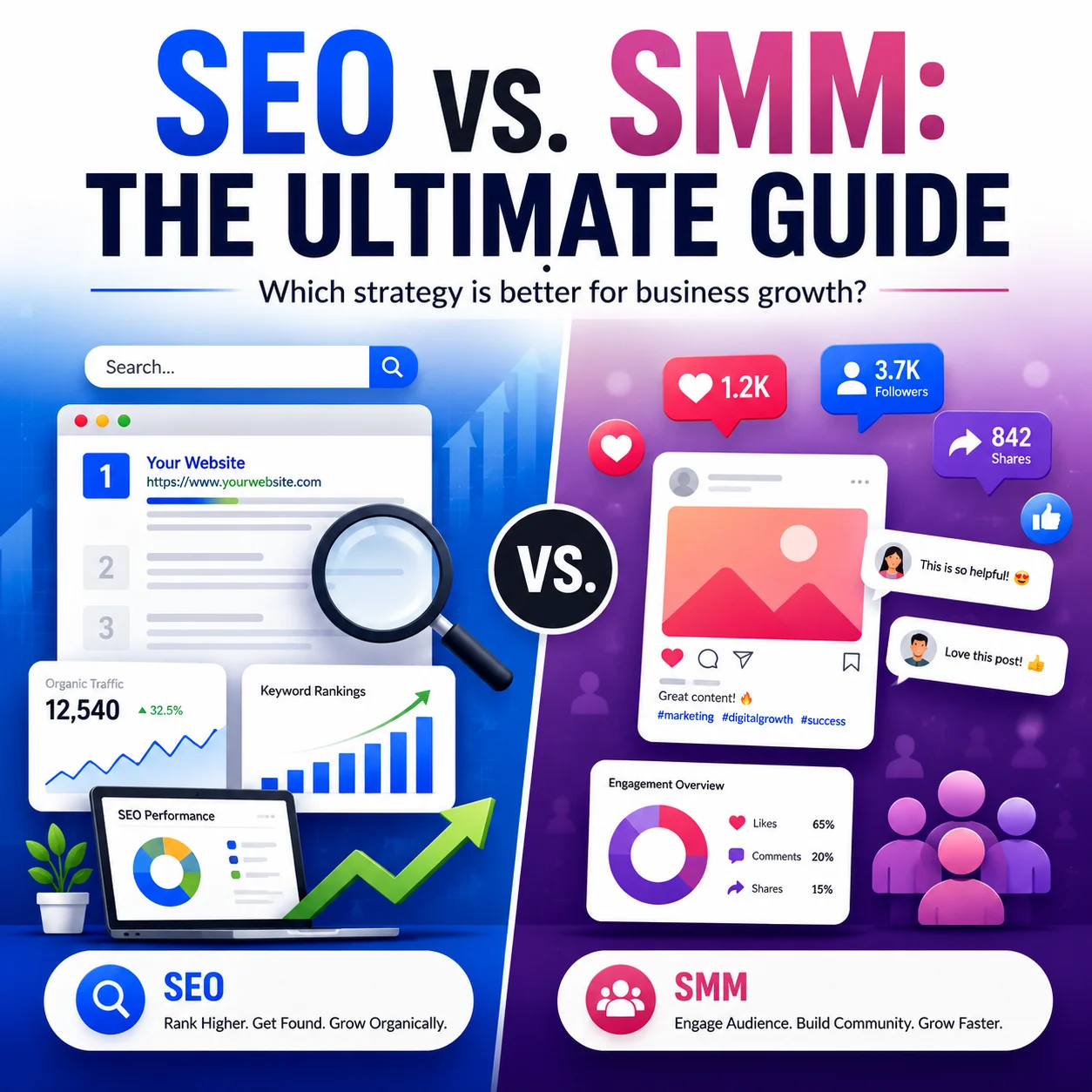
In today’s digital age, it is critical to find your business online in order to reach the right audience. Users search on Google, explore brands on Facebook, watch video on TikTok, and connect with others on Instagram, LinkedIn and YouTube. This is the place where social media marketing and SEO come in. SEO can help you improve your ranking in the search engines. SMM will help you to connect, engage and grow your business on social media.
But, many business owners compare SEO vs SMM as they both promote online growth in different ways. SEO is all about long term organic traffic, better ranks and search based leads. SMM is faster reach, brand exposure, customer connection, and community building. Your selection depends on your business goal, budget, audience and timing. In this article, we will talk about SEO, SMM, their similarities, differences, benefits and which technique is best for growth and sustainable online success.
SEO : Search Engine Optimization You must optimize for the content so that search engines can find it. This is the process of making changes to a website to improve its position in the search engine results. The Top Search Engines (Google, etc.) decide whether or not to serve a result based on relevancy, quality, user experience and trust. When people search for a service, product or information they usually go to the websites that appear on the first page of the search engine results. SEO will help your website show up in searches like this.
For example, if someone searches for “SEO service in Nepal,” "digital marketing agency in Nepal," or "video production company in Kathmandu," a well-optimized website is more likely to appear in the results.
SEO is not just keywords. This covers content quality, website speed, mobile friendliness, technical performance, user experience, backlinks, internal links and regular analysis. SEO is the art of getting organic traffic to your website. “Organic traffic” is the traffic that comes from unpaid search results.
SEO is made up of many different aspects that all work together to increase the rank and visibility of a website. A good SEO strategy considers all the important factors of the website. The three main types of SEO are: On-page SEO Off-page SEO Technical SEO All three are important for greater success in search engines but each has a different role to play.
On-page SEO is the optimization of elements and content that are seen on a web page. This helps search engines and users to understand better what the page is about. This includes optimisation of titles, headings, descriptions, images, content, URLs and links within the site. A well optimised page should be relevant to the target keyword, useful for the audience and easy to read.
Because it directly affects how search engines read your content, on-page SEO is important. If your page clearly answers the user's search question, it is more likely to rank.
Keyword research is the process of finding out the words and phrases people use while searching on the internet.
For example, individuals may look up terms like "SEO company in Nepal," "social media marketing agency in Nepal," "best digital marketing service," or "website design company in Kathmandu."
Understanding these keywords will help businesses create content that meets user preferences. Keyword research helps to find out the competitiveness of the search terms and the products that the consumers are looking for. An effective keyword research should be based on: search intent, search volume, keyword difficulty and business relevance Choosing the right keywords is important in attracting the right audience to the website.
Meta elements are a key component of on-page SEO. They tell the user and search engines what the page is about.
The meta title and meta description are the most important meta elements. The meta title is the clickable title in the search results and the meta description is a short summary of the page. A compelling meta title should include the primary keyword and a short explanation of the page’s subject matter. A meta description that is short, attractive and informative is likely to make users take action.
Header elements such as H1, H2 and H3 are important as well. They help consumers and search engines understand the structure of the page by organizing the content.
Content optimization is the process of improving the content of a website so that it is friendly for users and friendly for search engines. Good SEO is about relevant, informative, original and easy to read content around the target keyword. It should be truly useful and give a clear answer to user questions.
Content optimization involves the natural use of keywords, writing appropriate headings, including internal links, using images with meta text, improving readability and ensuring that the content is relevant.
For example, a blog about SEO vs. SMM should explain the objectives of both strategies, how they work, their similarities and differences, their costs and benefits, and what decision businesses should make.
High-quality content can increase website traffic, build trust, and improve search engine ranking.
Off-page SEO includes activities done outside your website to improve its trust, authority, and visibility. While on-page SEO focuses on your website content, off-page SEO focuses on external signals. These signals help search engines understand whether your website is reliable and valuable.
Off-page SEO includes backlinks, brand mentions, social sharing, business listings, guest posting, reviews, and local citations. A strong off-page SEO strategy helps build website authority and improves the chances of ranking higher in search results.
Link building is the process of getting links from other websites to your website. These links are called backlinks. Backlinks are important because they work like recommendations. When a trusted website links to your website, it can improve your website’s authority and credibility.
However, quality matters more than quantity. A few backlinks from relevant and trusted websites are more valuable than many low-quality links. Businesses can build backlinks through guest blogging, content promotion, PR articles, directory listings, partnerships, and useful resources. For long-term SEO success, link building should be natural, relevant, and ethical.
Social media presence can support SEO by increasing brand visibility and content reach. When businesses share website content on platforms like Facebook, Instagram, LinkedIn, TikTok, or YouTube, more people can discover the content. This can bring traffic to the website and increase brand awareness. Although social media signals may not directly guarantee higher rankings, a strong social media presence can support the overall digital marketing strategy.
For example, sharing blog posts, portfolio pages, service pages, and videos on social media can help more people visit the website and engage with the brand.
A strong social media presence also builds trust and helps customers recognize the business.
Local SEO is targeting location-based searches to improve visibility. This is crucial for companies reaching out to consumers in a particular city, region, or country.
For example, searches like “digital marketing agency in Kathmandu,” “SEO service in Nepal,” “studio rental in Kathmandu,” or “video production company near me” are local search queries.
Local SEO includes: optimizing the Google Business Profile, using local keywords, ensuring business details are accurate, gathering customer reviews, and listing the business in local directories. Local SEO can help Nepali businesses by increasing their visibility in local search results and Google Maps, and drawing the attention of local buyers.
Analytics and measurement are two important parts of SEO because they help businesses know how well they’re doing. Without data tracking it is difficult to assess what is working and what needs development. SEO performance can be measured using tools like Google Analytics, Google Search Console, and other SEO tools. These tools help track traffic, impressions, clicks, rankings, user behavior, and conversions.
By analyzing data, businesses can identify high-performing pages, weak pages, keyword opportunities, technical issues, and content gaps. Regular measurement helps improve SEO strategy over time.
In a nutshell, Technical SEO is about the technical health of a website. It helps search engines to crawl, index and understand the website rightly. The content on a website can be good but technical issues can affect the website’s rankings. A slow website, broken links, indexing issues, or poor mobile experience can reduce SEO performance.
Technical SEO includes site speed, mobile responsiveness, URL structure, sitemap, robots.txt file, canonical tags, structured data, HTTPS security, and crawl error fixing. A technically strong website improves both search engine performance and user experience.
URL structure is an important part of technical SEO. A good URL should be short, clear, and easy to understand.
For example, a URL like /services/search-engine-optimization is better than a confusing URL like /page?id=123.
Clean URLs help users understand the page topic before clicking. They also help search engines understand the content of the page. A good URL should include relevant keywords, avoid unnecessary numbers or symbols, and follow a simple structure.
Internal linking means linking one page of your website to another page within the same website.
For example, a blog about SEO vs SMM can link to SEO service pages, social media marketing service pages, digital marketing pages, and related blogs.
Internal links help users explore more content. They also help search engines understand the relationship between different pages. Good internal linking can improve website navigation, distribute page authority, and increase user engagement.
Site speed and mobile optimization have a massive impact on SEO and user experience. If the content takes too long to load, users will leave the website before they read it. This could result in a reduction in conversions and an increase in bounce rate.
It’s also important to optimize for mobile, as many consumers browse websites on their smartphones. It is very important that a website should be attractive and should work perfectly on desktop, tablet and mobile. To improve site speed and mobile performance, consider optimizing image size, using dependable hosting, removing unnecessary code and responsive design. A fast and mobile-friendly website creates a better experience for users.
Crawling and indexing websites are fundamental aspects of search engine optimization. Crawling is the process by which search engines find pages on a website using algorithms, or crawlers. Indexing is the process of storing and organizing the information in a database. Not crawled — means that the page is not crawled and indexed and may not appear in search results.
To improve crawling and indexing, businesses should optimize the robots.txt file, fix broken links, use canonical tags, and fix crawl errors. Further they should create an XML sitemap. A site that has been crawled and indexed sufficiently is more likely to show up in search engine results.
Structured data, also known as schema markup, helps search engines understand website content more clearly. Schema markup can tell search engines whether a page is a blog, service page, product page, FAQ, review, event, or local business page.
Using structured data can improve how your website appears in search results. Maybe it’d be helpful to give you full results with FAQs, ratings, article details or business info. FAQ schema and article schema are beneficial for websites. Local business schema can help search engines understand important business information for businesses.
SEO is the art and science of making sure that search engines can find, understand and rank pages on websites. Search engines crawl a website, this is the first step in the process. Once the crawl is finished the search engines will look at the technical signals, structure, links and on page content. Then add the document to the search index.
When you search, the search engine gives you relevant, high-quality, authoritative, user-friendly results. SEO enhances the website’s capacity to meet these positioning factors. It includes performance analysis, technical optimization, link building, local SEO, content optimization and keyword research.
SEO is often time-consuming but can bring sustainable growth and long-term traffic.
Search engine crawling is the process by which search engine bots visit web pages to find content. These algorithms navigate from page to page following links. They gather information about the technical details, images, links, content and structure of the page.
Websites are easier for crawlers to find pages with a clear structure and good internal linking. Crawling is the initial step in the process of a page appearing in search results. If search engines can’t crawl a page, that page may not be indexed.
After crawling a page, search engines analyze and store the page information in their index. An index is like a large database where search engines keep information about web pages. When users search for something, search engines check this index to find relevant results.
Indexing depends on content quality, technical setup, crawlability, and page accessibility. If a page has duplicate content, no-index tags, poor structure, or technical errors, it may face indexing problems. A properly indexed page has a better chance of appearing in search results.
Ranking algorithms are systems used by search engines to decide which pages should appear first in search results. Search engines look at many factors before ranking a page. These factors may include content relevance, keyword usage, backlinks, website authority, page speed, mobile friendliness, user experience, freshness, and search intent.
The exact ranking algorithm is not fully public. However businesses can improve their rankings by creating educational content, improving technical SEO, building authority and providing an excellent user experience. Search engine optimisation (SEO) is the process of improving these signals so that search engines can trust and rank your website.
The main aim of on-page optimization is to improve the components of a website. This involves optimizing titles, meta descriptions, headings, paragraphs, images, internal links, URLs and keyword placement. The aim is to make the page both user-friendly and search engine-friendly.
A well-optimized page should have a clear topic, proper structure, useful content and natural keyword usage. On-page optimization helps in keeping users engaged and increases the chances of ranking.
The main purpose of off-page optimization is to increase a website’s authority through external activities. This includes local citations, reviews, guest posting, online PR, social sharing, link building, and brand mentions.
Search engines use external signals to understand whether a website is trustworthy. If other reliable websites mention or link to your website, it can improve credibility. Off-page optimization is important for competitive keywords because authority plays a major role in ranking.
Content creation and optimization are two key parts of search engine optimization. Search engines are motivated to display relevant content to users. Businesses should therefore be creating content that answers questions, solves problems and provides clear, unambiguous information.
Content may include journals, service pages, landing pages, guides, FAQs, portfolio pages, case studies. Optimized content includes relevant keywords, suitable headings, internal links, images, and simple formatting. Good content can bring organic traffic, improve trust, and support conversions.
Technical SEO ensures that the website works properly for search engines and users. It includes improving page speed, mobile responsiveness, website structure, sitemap, robots.txt file, canonical tags, redirects, broken links, schema markup, and security.
Technical SEO makes sure search engines can crawl and index the website without any problems. It also improves user experience. A secure, fast and mobile-friendly website can amplify the potential of conversions and keep the interest of visitors.
Monitoring and analysis help businesses understand SEO performance. After SEO work is done, it is important to track results regularly. This includes checking traffic, ranking, clicks, impressions, bounce rate, conversions, and technical issues. Google Analytics and Google Search Console are useful tools for SEO monitoring.
By analyzing data, businesses can understand which pages are performing well and which need improvement. SEO is not a one-time task. It needs regular updates, tracking, and improvement.
SMM stands for Social Media Marketing. It is the use of social media platforms to market a business, product, service or brand . SMM is the process of creating posts, reels, videos, stories, captions, graphics, ads, and campaigns for Facebook, Instagram, TikTok, LinkedIn, YouTube, and Pinterest.
The main goal of SMM is to build brand awareness, increase engagement, communicate with customers, and generate leads or sales. Social media marketing (SMM) is different from SEO in the sense that it is directed to people when they are on social media platforms and not when they are searching for information. That means immediate visibility and direct engagement with your audience.
Depending on the business objective, target audience and budget there are a number of ways to implement social media marketing. Organic posting strategies are used by some organizations to build credibility. Some people buy ads to reach more people. Others use influencer marketing, content marketing, engagement campaigns, contests or giveaways:
The ideal social media marketing strategy varies from the type of business and the social media platform where the target audience is most active.
Content marketing in SMM is the creation of useful and engaging content for social media audiences. This can be in the form of blog posts, video posts, reels, infographics, carousel posts, testimonials, educational posts and brand stories. It’s not just about selling, it’s about getting attention and giving value.
For example, a digital marketing agency can help with branding, content planning, social media growth and SEO. This helps to build the trust of the audience.
Good content marketing can increase engagement, drive more traffic to your website and build brand authority.
SMM advertising is the promotion of content with paid ads on social media. Paid ads allow businesses to reach a larger, more targeted audience. Platforms such as Facebook, Instagram, TikTok, LinkedIn and YouTube allow targeting based on audience type, location, age, interests and behaviour.
Social media advertising is useful for lead generation, product promotion, event promotion, brand awareness, website traffic, and sales campaigns. Unlike organic posts, paid ads can deliver faster reach and measurable results.
Influencer marketing is a type of SMM where businesses collaborate with social media influencers or content creators. Influencers already have an audience that follows and trusts them. When they promote a product or service, it can help increase brand awareness and credibility.
This method works well for fashion, food, beauty, travel, education, entertainment, events, and lifestyle brands. However, choosing the right influencer is important. The influencer’s audience should match the business target audience.
Social media engagement means interacting with the audience through comments, messages, reactions, shares, and conversations. Engagement is important because social media is not only for promotion. It is also a communication platform.
Businesses should reply to customer questions, respond to comments, handle reviews, and maintain active communication. Good engagement builds trust, improves customer relationships, and increases brand loyalty.
Contests and giveaways are popular methods to increase social media engagement and reach. Businesses can ask users to like, comment, share, tag friends, or follow the page to participate. This can help increase visibility and attract new followers. Giveaways can be useful for brand awareness, product promotion, and audience growth.
However, contests should be planned properly. The goal should be to attract relevant audiences, not just random followers.
SMM works by reaching and engaging people through social media platforms. The process starts with setting clear goals. A business should know whether it wants brand awareness, engagement, leads, sales, website traffic, or customer support.
After that, the business identifies the target audience and chooses the right platform. Then, it creates content, publishes posts, runs ads if needed, engages with the community, and tracks performance. SMM works best when content is consistent, creative, and relevant to the audience.
The first step in SMM is defining goals and understanding the target audience. A business should clearly know what it wants to achieve. The goal may be to increase followers, generate leads, improve engagement, promote a service, or drive website traffic.
Understanding the target audience is equally important. This includes knowing their age, location, interests, behavior, needs, and online activity. When goals and audience are clear, it becomes easier to create the right social media strategy.
After defining goals and audience, the next step is choosing the right social media platforms.
Not every platform is suitable for every business. Facebook is useful for mass reach and local audiences. Instagram is strong for visual branding. TikTok is effective for short videos and viral content. LinkedIn is better for professional and B2B marketing. YouTube is useful for video content and long-term visibility. Choosing the right platform helps businesses save time and reach the right people.
A content strategy is a plan for what to post, when to post, and how to communicate with the audience. It includes content topics, post formats, design style, caption tone, posting frequency, video ideas, campaign themes, and call-to-action. A good content strategy should match the brand identity and audience interest.
For example, a business can use educational posts, reels, testimonials, service highlights, behind-the-scenes content, offers, and customer stories.
Without a content strategy, social media posting becomes random and less effective.
Community engagement is an important part of SMM. Businesses should not only post content but also interact with followers. This includes replying to comments, answering messages, responding to reviews, and joining conversations. Engagement helps build trust and shows that the brand cares about its audience.
A business with active communication can create stronger customer relationships and improve brand loyalty.
Social advertising and influencer marketing can improve the reach and impact of SMM. Paid social ads help businesses reach targeted audiences quickly. Influencer marketing helps businesses use the trust and reach of creators.
Both methods are useful for campaigns, product launches, brand awareness, lead generation, and promotions. When used properly, social advertising and influencer marketing can increase engagement, traffic, and conversions.
Monitoring and analysis are important for improving SMM performance. Businesses should track reach, impressions, engagement, followers, comments, messages, clicks, leads, and conversions. Social media analytics helps identify which content works best and which needs improvement.
For example, if reels are getting more engagement than static posts, the business can create more video content. If one ad campaign is generating better leads, the budget can be adjusted accordingly.
Regular analysis helps make smarter marketing decisions.
SEO and SMM are different strategies, but they have several similarities. Both are used to improve online visibility and support business growth. Both require content, audience research, consistency, and performance tracking.
SEO focuses on search engines, while SMM focuses on social media. However, both help businesses reach potential customers online. When combined properly, SEO and SMM can create a stronger digital marketing strategy.
One major similarity between SEO and SMM is that both improve online visibility. SEO improves visibility on search engines like Google. SMM improves visibility on social media platforms like Facebook, Instagram, TikTok, and LinkedIn. Both help businesses appear in front of potential customers.
A business with strong SEO and active social media presence has more chances to be discovered by its target audience.
Both SEO and SMM focus on reaching the right audience. In SEO, audience targeting is done through keyword research and search intent. Businesses create content based on what users are searching for. In SMM, audience targeting is done through demographics, interests, location, behavior, and platform activity.
Both methods help businesses connect with people who are likely to be interested in their products or services.
Content strategy is important in both SEO and SMM. SEO needs blogs, service pages, landing pages, FAQs, and optimized website content. SMM needs posts, reels, stories, captions, videos, and graphics. In both strategies, content should be useful, relevant, and aligned with the audience’s needs.
A strong content strategy helps attract attention, build trust, and improve conversions.
SEO and SMM both require analytics and measurement. In SEO, businesses track rankings, traffic, clicks, impressions, bounce rate, conversions, and technical issues. In SMM, businesses track reach, engagement, followers, messages, clicks, leads, and ad performance.
Measurement helps businesses understand what is working and what needs improvement. Without analytics, digital marketing becomes guesswork.
SEO and SMM can be integrated to create better results.
For example, SEO blogs can be shared on social media to bring more traffic. Social media questions can be used as blog topics. Keyword research can help improve social media captions and video titles.
Social media can increase brand awareness, while SEO can capture people when they search for the brand or service later. Together, SEO and SMM support a complete digital marketing strategy.
SEO and SMM have different platforms, goals, timelines, and working methods. SEO focuses on improving website visibility on search engines. SMM focuses on promoting brands and engaging audiences on social media platforms. SEO usually takes more time but gives long-term results. SMM can give faster reach, especially through paid ads.
Both are useful, but they should be used based on business goals.
The main objective of SEO is to improve website ranking and attract organic traffic from search engines. SEO helps businesses appear when people search for specific keywords related to their products or services. The main objective of SMM is to build brand awareness, increase engagement, communicate with customers, and promote products or services on social media. SEO is more focused on search visibility. SMM is more focused on audience interaction and brand presence.
SEO mainly works on search engines such as Google, Bing, Yahoo, and DuckDuckGo. The focus of SEO is to optimize a website so that it appears higher in search results. SMM works on social media platforms such as Facebook, Instagram, TikTok, LinkedIn, YouTube, Pinterest, and X. The focus of SMM is to create content and campaigns that reach and engage social media users.
SEO reaches users who are actively searching for information, products, or services. This means SEO traffic usually has higher intent because users already know what they are looking for. SMM reaches users based on their interests, behavior, location, and social media activity. Social media users may not be searching for your service, but strong content or ads can create interest and awareness.
SEO is usually a long-term strategy. It takes time to rank on search engines because it involves content creation, technical improvement, authority building, and regular optimization. However, once SEO starts working, it can bring traffic for a long time.
SMM can provide faster visibility, especially with paid ads. A social media campaign can quickly reach thousands of people. However, social media content usually has a shorter life span, so consistent posting and campaign management are important.
SEO focuses on search intent. This means users are actively searching for a solution, product, service, or information.
For example, someone searching “best SEO service in Nepal” may already be interested in hiring an SEO company.
SMM focuses more on awareness and engagement. Users may not be searching for your product, but your post, reel, or ad can attract their attention. SEO captures demand. SMM helps create demand.
SEO is often a long-term investment. It may require website audit, keyword research, content writing, technical SEO, link building, and monthly reporting. The cost of SEO depends on website size, keyword competition, content needs, and technical issues.
SMM may require content creation, graphic design, video production, page management, ad budget, and campaign monitoring. SMM can produce faster results, but it often needs regular spending to maintain reach and engagement.
Both SEO and SMM can be cost-effective when planned properly.
|
SEO |
SMM |
|
Improves website ranking on search engines |
Builds brand awareness and engagement on social media |
|
Works mainly on Google, Bing, Yahoo, and DuckDuckGo |
Works mainly on Facebook, Instagram, TikTok, LinkedIn, YouTube, and Pinterest |
|
Targets users with search intent |
Targets users based on interests, behavior, and demographics |
|
Long-term strategy |
Quick and long-term strategy depending on campaign |
|
Best for organic traffic and qualified leads |
Best for engagement, awareness, and communication |
|
Cost-effective over a longer period |
Needs regular content and ad investment |
|
Content has a longer life span |
Content usually has a shorter life span |
|
Performance measured through ranking, clicks, traffic, and conversions |
Performance measured through reach, engagement, messages, leads, and ads |
Choosing between SEO and SMM depends on your business goal. If your goal is long-term website traffic, better Google ranking, and organic leads, SEO should be your priority. SEO is useful for businesses that want to appear when people search for their services. If your goal is quick awareness, social engagement, brand communication, and campaign promotion, SMM is a strong option.
However, the best choice is not SEO or SMM. The best choice is both. SEO helps people find your business when they search. SMM helps people discover and remember your business when they scroll.
For example, a business can use SEO to rank service pages and blogs on Google. At the same time, it can use social media marketing to promote those blogs, showcase services, share videos, and engage with customers.
A complete digital marketing strategy should combine SEO, SMM, content marketing, video production, graphic design, paid ads, and regular analysis.
Arya Digital Production helps businesses improve online visibility through SEO services, social media marketing, digital marketing, video production, reels, photography, podcast production, and creative content services.
If you want sustainable online growth, SEO and SMM should work together.
- The full form of SEO is Search Engine Optimization. The full form of SMM is Social Media Marketing.
SEO helps improve website visibility on search engines. SMM helps promote a brand through social media platforms.
- SMM, or Social Media Marketing, is the process of promoting a business, product, or service through social media platforms. It includes creating posts, reels, videos, stories, ads, and campaigns to reach and engage audiences. In simple words, SMM means using social media to grow brand awareness, connect with customers, and promote business services.
- SEO focuses on search engine ranking and website traffic. Social media marketing focuses on brand awareness, audience engagement, and social platform promotion.
- SEO is better for long-term organic traffic and search visibility. However, combining SEO with social media marketing gives better overall results.
- Yes, social media marketing can support SEO by bringing traffic to website content, increasing brand awareness, and helping content reach more people.
in learning more about your project.
