Author: ADP Team
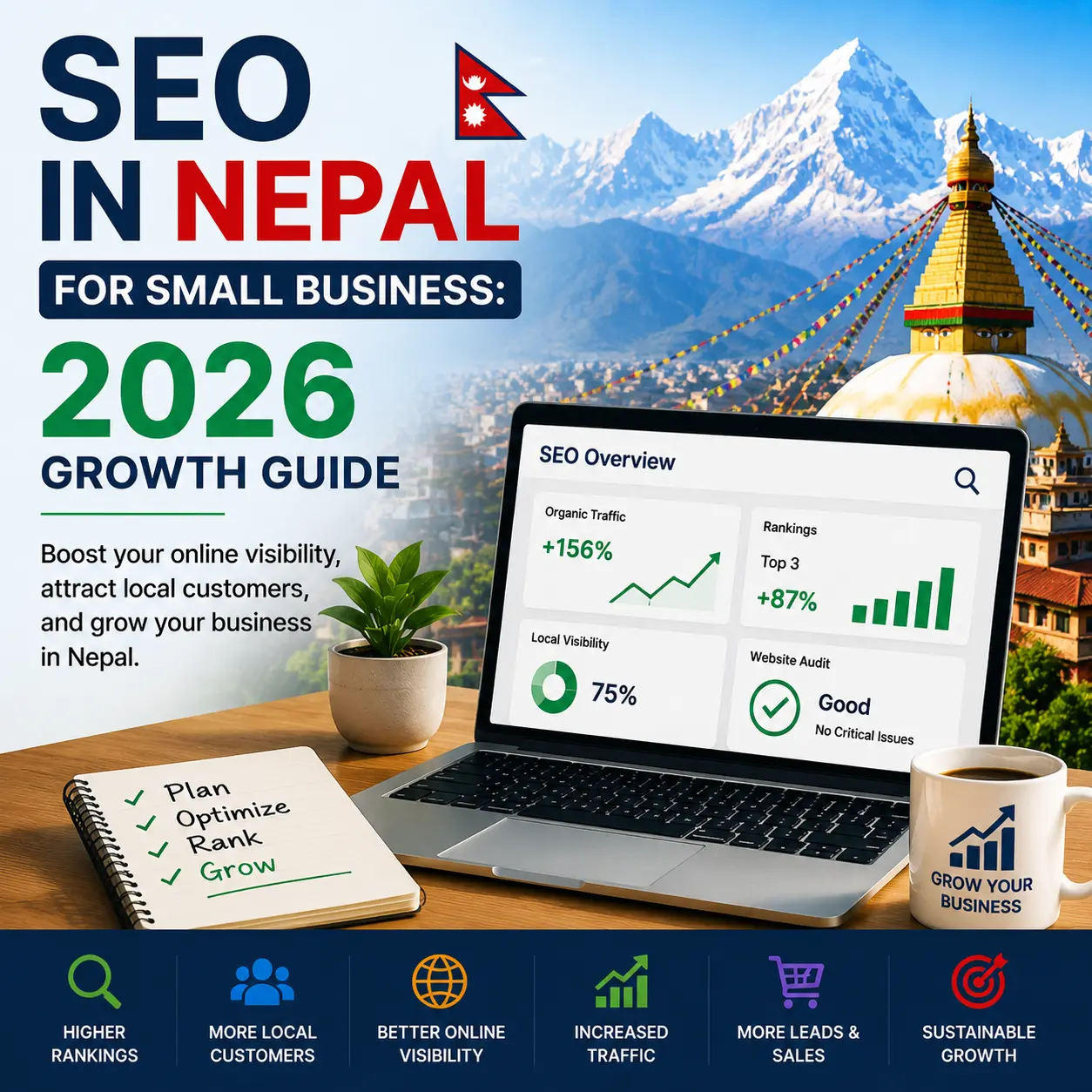
Many small businesses in Nepal start their journey online with a Facebook page, a couple of boosted posts and a basic website. This is a good beginning, but it won't work unless potential customers are able to locate the business on Google. In 2026, individuals will do more research to select a company. They will search online, read reviews, visit websites, check social media activity, and look for signs of trust.
If your business is missing from relevant search results, competitors may receive those inquiries instead. This is where SEO matters. SEO in Nepal for small businesses is not just about ranking pages; it helps make your business more visible, clear, and accessible. SEO can be used to link your website, service pages, blogs, local presence and trust signals together to create sustainable growth and more qualified inquiries over time, if you do it right.
SEO stands for Search Engine Optimization. In simple words, it means improving your website so search engines like Google can understand your pages and show them to people searching for your products or services. Real SEO, however, is not about keyword stuffing. That old way creates weak and unnatural content. Modern SEO is all about knowing what your customers are searching for and making pages that actually answer their search.
A restaurant, for instance, would like to show up when people look up for food in the immediate vicinity. A studio is looking to be found when people are looking for rental space, podcast set up or video shoot location. A consultancy wishes to be visible in course and/or visa searches. A creative agency wants to appear for SEO, digital marketing, video production, design, and branding services.
That means SEO should start with the customer, not the keyword. What questions does the customer have? What is the issue that they are addressing? What facts will they need to consider? If your web page can clearly answer these questions, then SEO will be more useful and natural.
A proper SEO service in Nepal should improve your website for both users and search engines, not only for ranking tools.
Nepal's small businesses are facing a competitive digital landscape. There are a lot of businesses now with websites, social media pages, business listings, reels and ads. Because of this, simply being online does not guarantee visibility.
A customer may search for your service today, but if your website is not properly optimized, they may never see your business. They may contact another company that has a clearer website, better local visibility, stronger content, and more trust signals.
SEO helps small businesses because it reaches people who already have intent. Someone searching on Google is usually looking for information, comparison, pricing, location, or a provider. This is not the same as displaying an ad to a person who isn't ready.
Small businesses can benefit from good SEO by:
For small businesses with limited budgets, SEO is valuable because the work builds over time. A well-optimized page can continue to bring visitors if it is updated, internally linked, and technically healthy.
Many small businesses make the mistake of beginning their SEO campaign with random keywords. They wish to rank for the general terms but they don't first establish what they are looking for from SEO.
Before choosing keywords, ask:
For instance, a company might wish to target the term “SEO”, but this is a very general term. “SEO in Nepal for small business” might be a better target, as it is more clearly defined. It indicates that the searcher is probably a business owner seeking SEO services in Nepal.
For small businesses, it's important to target keywords that align with actual customer queries. They can be service keywords, location keywords, cost keywords, problem keywords, and comparison keywords.
Good SEO is not about chasing every keyword. It is about choosing the keywords that can bring the right audience.
When you have a clear process, SEO is easier. Small businesses should have a roadmap, rather than doing random blogs and random changes.
A practical SEO roadmap is as follows:
To begin with, know the business and the target customers. Then review the website to find issues. After that, research keywords based on services and customer intent. Once the keywords are clear, improve the important pages. Then publish supporting content, build internal links, improve local SEO, monitor results, and adjust the strategy.
This process matters because SEO is not one activity. It is a system.
A good SEO roadmap includes:
For small businesses, the first priority should be the most important service pages. Without those pages, blogging won't do much to help. Your service pages should clearly explain what you do, who you help, how your service works, and how customers can contact you.
Before creating new content, it’s essential to evaluate the current website. Many SEO issues are hidden within the site’s structure.
A basic SEO audit should include checks for:
For websites built with dynamic frameworks, this is particularly important because routes, paginated content, and automated sitemap or canonical tag generation may be handled in code. SEO professionals don’t always need to write code, but they should understand what to check and how to guide developers effectively.
For example, if a service page is important, it should be indexable, self-canonical, included in the sitemap, and internally linked from relevant blogs or service pages.

On page SEO is the optimization of the content and structure of a page. This is one of the most manageable aspects of SEO.
A proper page should have:
For a service page, the content should not only say “we provide the best service.” It should explain the actual service in a way that helps customers.
A strong service page should answer:
What is the service?
Who needs it?
What problems does it solve?
What is included?
How does the process work?
How long does it take?
What result can customers expect?
Why should they trust the company?
How can they contact you?
This makes the page useful. It also assists Google to grasp the subject of the page.
On-page optimization is likely to provide quicker results for small businesses as many websites already have pages, but they are shallow, unstructured and not linked internally.
Local SEO helps your business appear for location-based searches. This is important because many customers in Nepal search using location terms such as “Kathmandu,” “near me,” “in Nepal,” “in Baneshwor,” or other city-based phrases.
A small business with local customers should optimize both its website and Google Business Profile.
Important local SEO tasks include:
For example, if a business is based in New Baneshwor, Kathmandu, it should ensure that its address, contact number, service area and business information are uniform.
Local SEO is effective because people who are searching locally tend to have a higher intent. They are not only studying. They may be willing to call, visit, or schedule a service.
Blogs can be helpful for SEO, but only if they have a purpose. If you are not writing blogs that are relevant to target pages or actual customer questions, then it will not help.
A good support blog should do three things:
For instance, a blog on SEO for small businesses can complement the SEO service page. A blog about choosing an agency can support a digital marketing page. A blog about Facebook Ads can support social media services. A blog about studio setup can support studio rental.
Here are some great blog ideas for small businesses:
Arya Digital Production has an edge here as it can provide design, video, reels, photography and multimedia support to the content. A blog topic can be a carousel, a reel, a short explainer video or a social media campaign. This helps one idea work across multiple platforms.
Technical SEO makes sure Google can crawl, index, and understand the website properly. If technical SEO is weak, even good content may not rank.
Small businesses should pay attention to:
For example, if an important page is not included in the sitemap or has a wrong no index tag, it may not appear in search results. If the same content exists on multiple URLs, Google may not know which one to rank. If the page is slow on mobile, users may leave before reading.
Technical SEO should be checked regularly, especially after website updates, new page creation, redesigns, or URL changes.

Many small businesses treat SEO, social media, and ads as separate work. In reality, they perform better when connected. SEO helps people find your business through Google. Social media helps people check your activity and trust your brand. Ads help bring quick attention to offers, services, or campaigns.
For example, a customer may first discover your blog on Google. Then they may check your Instagram or Facebook page. After that, they may contact you through Messenger, WhatsApp, or phone. If your website and social media look disconnected, the customer may lose trust.
This is why working with a digital marketing agency can help small businesses create a connected strategy instead of scattered marketing. SEO builds long-term search visibility. Social media builds relationships and recall. Ads bring speed. Content connects everything.
Links are still important, but quality matters more than quantity. Small businesses should avoid cheap backlink packages that promise hundreds of links. These can look unnatural and may harm long-term SEO.
Good link building for Nepal-based businesses can include:
The goal is not just to get links. The goal is to build online trust. A link from a relevant local website is usually more useful than many random low-quality links.
Small businesses can also build trust through reviews, case studies, testimonials, business profiles, and consistent branding.
SEO takes time because Google needs to discover your pages, understand your content, compare it with competitors, and see whether users find it useful.
For low-competition long-tail keywords, some movement can happen within a few weeks. For medium keywords, it may take three to six months. For competitive keywords, it can take longer.
A realistic SEO timeline may look like this:
For a 30-day sprint, the target should not be unrealistic promises. The target should be foundation building, indexing, fixing major issues, improving important pages, publishing support content, and tracking keyword movement.
Many small businesses start SEO with good intention but weak planning.
Common mistakes include:
The biggest mistake is writing content only for Google. Content should first help the reader. If the reader understands the topic and finds the page useful, the content is more likely to support SEO naturally.
Arya Digital Production is not only focused on SEO as a separate task. The brand works across digital marketing, SEO, social media, content, graphics, reels, videos, podcasts, photography, multimedia production, and studio-related creative services. This matters because small business SEO needs more than keywords. A business needs clear pages, useful blogs, strong visuals, regular social media, good video content, and consistent brand communication.
For example, one SEO topic can become a blog, a social media carousel, a reel, a short explainer video, or a campaign idea. This gives small businesses more value from the same content topic.
Arya Digital Production’s mission around “Digital Solution for Digital Nepal” also matches the needs of Nepali businesses that want local understanding with creative execution. The team understands how SEO, content, design, video, and social media can work together for business growth. For businesses that also need social visibility, working with a social media marketing agency can help connect Google visibility with active brand communication.
You can also learn more about the company through Arya Digital Production.
Starting SEO does not have to be complicated. Start with the pages that matter most.
Use this simple process:
If you want to understand budget planning before starting, you can also read about SEO cost in Nepal.
The most important thing is consistency. SEO improves when the website is updated, tracked, and improved regularly.
Is SEO useful for small businesses in Nepal?
Yes. SEO helps small businesses appear when customers search for products or services online. It is useful for consultancies, restaurants, studios, agencies, ecommerce stores, clinics, training centers, and local service providers.
How much does SEO cost for small businesses?
SEO charges in Nepal are between NRS 11000 and 28000 per month (60,000 - 3,00,000 a year).
What are the 4 types of SEO?
The 4 primary types of SEO are On-Page, Off-Page, Technical, and Local SEO. Together, they build a holistic strategy that increases your website's search engine visibility, organic traffic, and domain authority.
Can SEO bring leads?
Yes, SEO can bring leads when the website targets the right keywords, ranks for relevant searches, has helpful content, and makes it easy for users to contact the business.
Do I need technical SEO?
Yes. Technical SEO helps Google crawl and index your website. Without technical SEO, even good content may not perform properly.
SEO in Nepal for small businesses is not about tricks, shortcuts, or keyword stuffing. It is about helping customers find your business when they are already searching for your services. A proper SEO plan improves your website structure, content quality, local visibility, technical health, internal links, and search performance. It helps your business become easier to find, easier to trust, and easier to contact.
For small businesses in Nepal, SEO is a long-term investment. It may take time, but consistent work can bring organic traffic, better visibility, and more qualified inquiries.Start with a website audit, improve your service pages, fix technical issues, build local SEO, publish helpful content, and track performance. With the right strategy and a creative partner like Arya Digital Production, your business can build stronger online visibility in 2026 and beyond.
in learning more about your project.
